I only very rarely - hardly ever - give up on a book, but instead keep trudging on, however reluctantly, towards the last page. It took me nearly three months to reach the end of this one, which is a fair indicator of the amount of reluctance.
It isn't that it is a bad book, but on the contrary is very well written and has won both praise and actual awards (H. W. Fisher Best First Biography Award, Costa Book Awards winner). It is more the case that the more I read about Edward Thomas, the less I liked him. And the less persuaded I became that he was a good poet. Yes, he wrote a handful of good poems. Everyone knows "Adlestrop", and deservedly so. But a handful of good poems doesn't make a great poet.
The thing is, I'm not a great lover of English pastoral. When the curfew tolls the knell of parting day, my grateful reflection is only that it must be gin o'clock. And anyway, Gray did English pastoral better than Thomas, as did A. E. Housman, in my view.
Thomas was a brute to his family, whom he treated abominably. And yet the pity in his poetry is mostly self-pity. Maybe if he had lived beyond the war, he would have muscled up a bit, but I doubt it.
So now, what do I read next? I have two travel books put by, both of which I want to read, but first I think I'd like something light, easy and amusing...
Thursday, 7 November 2013

Sunday, 8 September 2013
Cherubim, seraphim and velociraptors
Coming home from shopping yesterday, I sat on the bus behind a grandmother with a small child. The child had been bought a toy dinosaur, which was the subject of conversation.
Child: The dinosaurs all died...
Grandmother: Yes, that's right, they all died thousands of years ago. [Which betrayed a certain lack of awareness of geological time, but let it pass].
Child: They all died and went (gesturing to the ceiling of the bus - which was a single-decker, by the way) up there.
Grandmother: Yes, they all died and went to heaven.
This gave me an insight into the nature of heaven that makes me wonder whether I want to go there any more. It will be bad enough if it is filled with rosy-cheeked, bare-bottomed cherubim floating winsomely about getting in the way, but what is it going to be like with velociraptors galumphing around as well? And does it not demonstrate a shocking lack of accuracy on the part of the Old Masters who painted the next world, that not one single tyrannosaurus rex is depicted seated in glory around the heavenly throne?
Child: The dinosaurs all died...
Grandmother: Yes, that's right, they all died thousands of years ago. [Which betrayed a certain lack of awareness of geological time, but let it pass].
Child: They all died and went (gesturing to the ceiling of the bus - which was a single-decker, by the way) up there.
Grandmother: Yes, they all died and went to heaven.
This gave me an insight into the nature of heaven that makes me wonder whether I want to go there any more. It will be bad enough if it is filled with rosy-cheeked, bare-bottomed cherubim floating winsomely about getting in the way, but what is it going to be like with velociraptors galumphing around as well? And does it not demonstrate a shocking lack of accuracy on the part of the Old Masters who painted the next world, that not one single tyrannosaurus rex is depicted seated in glory around the heavenly throne?
Saturday, 24 August 2013
Levens Hall and Arnside
I have been wanting to go to Levens Hall for years - literally, years - but it is quite a long way from Grandma's and, crucially, isn't always open, and certainly not at the times we've been likely to be in the area. This time, however, I stamped my little foot and tossed my pretty curls (metaphorically in both cases, as I have neither) and on Monday off we went. I will admit that I have no interest in the house but only in the gardens, where the topiary is the main feature, which is why it is such a shame that the gardens are not open in winter when their structure would be most appreciated.
It wasn't a great day, weather-wise, but it remained dry, and possibly the lack of sunshine deterred others from visiting, so the gardens were fairly empty and it was possible to wander freely. Beyond the topiary, which was amazing, the gardens were laid out in a formal structure within which there was just the amount of wildness and disorder that indicated some very careful and well-considered gardening.
And there was an excellent cafe, which always helps. Not that it stopped us diving straight into the Ramblers Cafe (excellent Brie and walnut sandwich, which please don't mention to Daughter, who is my diet guru and certainly wouldn't allow Brie and possibly wouldn't have allowed sandwich either, especially if she had found out about the lemon drizzle cake at Levens Hall - she is very (and quite rightly) strict) when we went on to Arnside. (Silly question, really, and Husband should have known better - "Would you like some thing to eat now, or after your walk?" Why not both?) Not that Arnside looked exactly like the photos on the tourism website, but it is a nice place, with a long railway bridge across the estuary and fantastic views across Morecambe Bay. The sun came out as well, and we pottered along beside the water and then came back to sit in a sheltered spot, just like all the other old biddies. I'm not sure I would describe it as "holiday resort", as most of the accommodation seemed to be old folks' homes, and there wasn't a lot to do if you wanted more than pottering and grazing. But then, who would?
It wasn't a great day, weather-wise, but it remained dry, and possibly the lack of sunshine deterred others from visiting, so the gardens were fairly empty and it was possible to wander freely. Beyond the topiary, which was amazing, the gardens were laid out in a formal structure within which there was just the amount of wildness and disorder that indicated some very careful and well-considered gardening.
And there was an excellent cafe, which always helps. Not that it stopped us diving straight into the Ramblers Cafe (excellent Brie and walnut sandwich, which please don't mention to Daughter, who is my diet guru and certainly wouldn't allow Brie and possibly wouldn't have allowed sandwich either, especially if she had found out about the lemon drizzle cake at Levens Hall - she is very (and quite rightly) strict) when we went on to Arnside. (Silly question, really, and Husband should have known better - "Would you like some thing to eat now, or after your walk?" Why not both?) Not that Arnside looked exactly like the photos on the tourism website, but it is a nice place, with a long railway bridge across the estuary and fantastic views across Morecambe Bay. The sun came out as well, and we pottered along beside the water and then came back to sit in a sheltered spot, just like all the other old biddies. I'm not sure I would describe it as "holiday resort", as most of the accommodation seemed to be old folks' homes, and there wasn't a lot to do if you wanted more than pottering and grazing. But then, who would?
Saturday, 17 August 2013
Maryport
Yesterday we went to Maryport, which is only about 20 miles from Grandma's, on the coast. It is seaside. So there I was, expecting seaside fun. And where was I taken? To the Roman museum. Yes, the Roman museum. We live in St Albans, remember, where we are surrounded 24/7 by the ruins of Verulamium and you can hardly walk through town without finding someone dressed up as a centurion. I've had it up to here with Romans.
Now, to be fair, it was an excellent museum. (Despite the crucial lack of a cafe, so no sustaining cup of tea and wedge of homemade cake). And we did get to go on a guided walk to the current excavation, which was interesting. No, it really was.
And then we went to Allonby - more seaside. Another nice place, but its glory days long gone, as witness the tourist information board.

We had an ice-cream, eaten in true English style, in the street, eyes streaming from the bitter wind and everyone else huddled in fleeces or 4x4's, or both.
And then, after a walk along the new cycle track (Hadrian's cycle track, apparently. And you thought he only built walls?) we tried to find something to eat, which was a lot harder than it should have been, but after finding a fish and chip shop (up for sale) and a recommended pub (closed), we finally settled at the Royal Oak at Curthwaite. Not bad, although their claim that all food was locally sourced was true only if you counted buying the balti sauce at a local supermarket. And the music (a Beatles compilation) was on a tape loop which repeated every hour, so we could play a memory game of trying to remember which song came next... But service was friendly (we were strangers and they didn't try to stone us) and God bless them, they were open and willing to feed us, which made them pretty exceptional in West Cumberland.
Now, to be fair, it was an excellent museum. (Despite the crucial lack of a cafe, so no sustaining cup of tea and wedge of homemade cake). And we did get to go on a guided walk to the current excavation, which was interesting. No, it really was.
And then we went to Allonby - more seaside. Another nice place, but its glory days long gone, as witness the tourist information board.
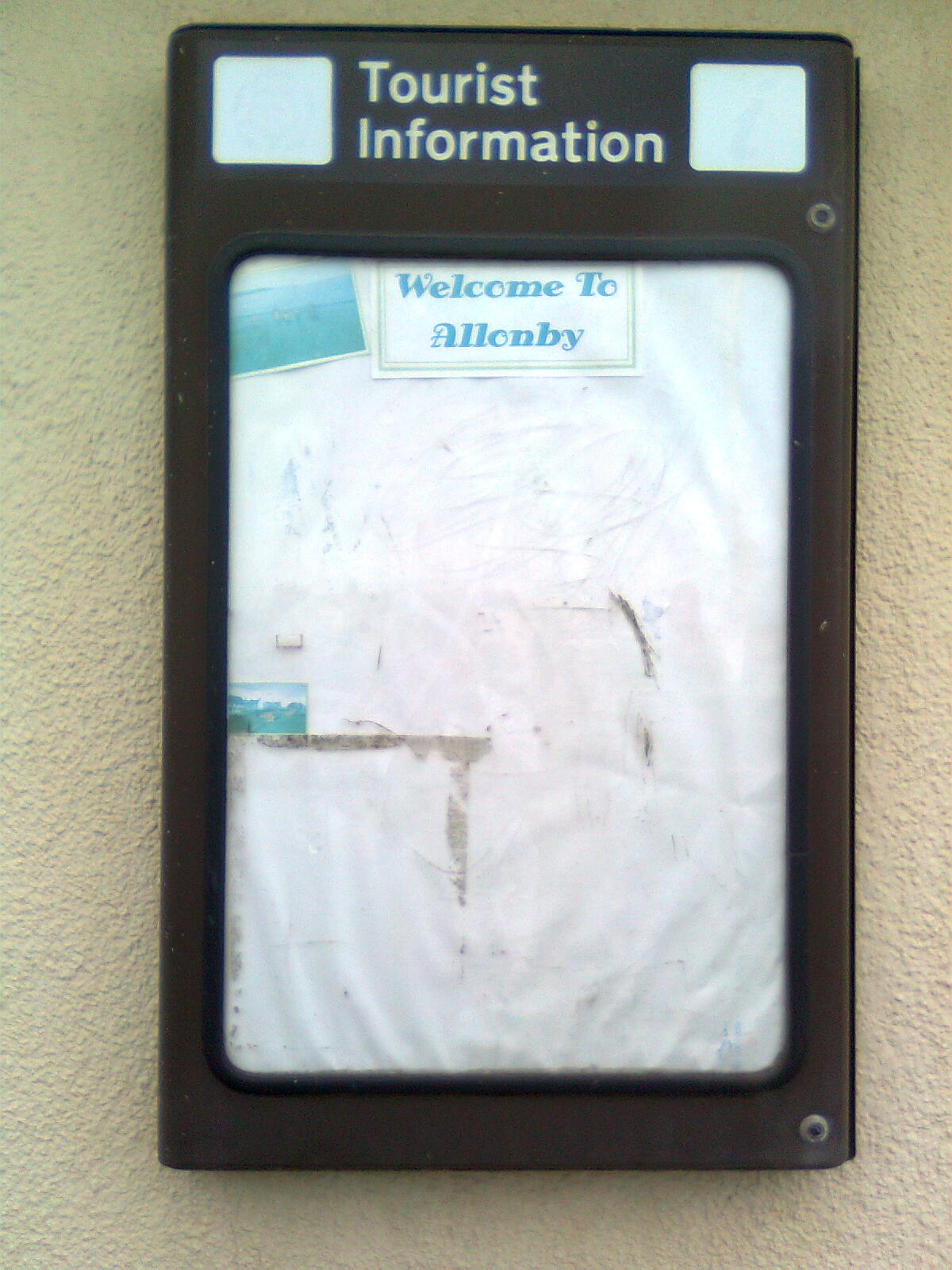
We had an ice-cream, eaten in true English style, in the street, eyes streaming from the bitter wind and everyone else huddled in fleeces or 4x4's, or both.
And then, after a walk along the new cycle track (Hadrian's cycle track, apparently. And you thought he only built walls?) we tried to find something to eat, which was a lot harder than it should have been, but after finding a fish and chip shop (up for sale) and a recommended pub (closed), we finally settled at the Royal Oak at Curthwaite. Not bad, although their claim that all food was locally sourced was true only if you counted buying the balti sauce at a local supermarket. And the music (a Beatles compilation) was on a tape loop which repeated every hour, so we could play a memory game of trying to remember which song came next... But service was friendly (we were strangers and they didn't try to stone us) and God bless them, they were open and willing to feed us, which made them pretty exceptional in West Cumberland.
Tuesday, 13 August 2013
The soldier's return, by Melvyn Bragg
Now that there is no second-hand bookshop in St Albans, not since Paton's closed, I am thrown back onto the Oxfam bookshop which, to be fair, isn't bad. However, the stock isn't large and the range isn't great, so any choice is based upon serendipity. I picked up Melvyn Bragg not because I am a special fan of his writing but because we are shortly (tomorrow, in fact) going up to Grandma's, and the nearest town to Grandma is Wigton, which is where Mr Bragg was born and educated (at the same school as Husband, in fact, though not at the same time). This book is based in Wigton, and to such an extent that the town is practically one of the major characters.
Set just after World War 2 (hence the title) it is quite a gripping read and I was genuinely curious to find out how it would end, which wasn't how I expected, but I'm not going to give the plot away. It is well-structured and well-written but I am never sure who books like this are written for - it doesn't have the clever-clever tricks of style of a really literary novel (and not necessarily any the worse for it), but neither is it a rollicking romp, so perhaps it is aimed at Mr Bragg's Radio 4 audience, and I suppose I probably count as one of them.
Knowing that I would finish the book today and wanting another to take away with me, and not being in St Albans, the next book came from the hospice shop in Marshalswick (you do get a better class of cast-offs in Marshalswick, so the charity shops are worth a browse, though precious few books amongst them) and only when I got it home did I realise how similar the two books are in appearance.

This next one is an account of the last five years of the life of the poet Edward Thomas, so we all know how that's going to end.
Set just after World War 2 (hence the title) it is quite a gripping read and I was genuinely curious to find out how it would end, which wasn't how I expected, but I'm not going to give the plot away. It is well-structured and well-written but I am never sure who books like this are written for - it doesn't have the clever-clever tricks of style of a really literary novel (and not necessarily any the worse for it), but neither is it a rollicking romp, so perhaps it is aimed at Mr Bragg's Radio 4 audience, and I suppose I probably count as one of them.
Knowing that I would finish the book today and wanting another to take away with me, and not being in St Albans, the next book came from the hospice shop in Marshalswick (you do get a better class of cast-offs in Marshalswick, so the charity shops are worth a browse, though precious few books amongst them) and only when I got it home did I realise how similar the two books are in appearance.

This next one is an account of the last five years of the life of the poet Edward Thomas, so we all know how that's going to end.
Tuesday, 30 July 2013
Puck of Pook's Hill, by Rudyard Kipling
This is not the most obvious book to start a new resolution - to blog about what I've been reading - but I came across it on the shelf when I was doing the dusting and couldn't remember whether I had read it so long ago as to have forgotten it, or whether I had never read it at all. It is a yellowing Papermac edition that cost me 45p when I bought it, which from the date inside was in September 1972. So that's more than 40 years ago.
I'm not even sure whether it is meant to be for children or for adults, though it isn't an overtly children's edition. Someone who saw me reading it commented that Kipling has a dark side, but I never found it in this book.
Not being much of a historian, I can't comment on the book's veracity but suspect it is a carefully airbrushed version of events. Perhaps if I had been more of a historian I would have been more annoyed by it, but although I recognise its sentimentality I didn't find it so cloying as to be bothered by it.
Its charm, as far as I am concerned, came from its setting in Sussex. Having been brought up on the Kent-Sussex border, and having had many family holidays on the Sussex coast not so far from Pevensey, the depiction of the sun-dappled past was like getting into a warm bath. Of course I don't remember as far back as 1906, when the book was first published, but even allowing for false and selective memory there was something immediately familiar and comforting about it.
It also had the great advantage for a commuter of being broken into separate, albeit related, stories, each one just about the right length for a journey. Which is no way to judge literature, I know, but is a factor when it comes to choice of reading.
So - a pleasant read but not a life-enhancing one and I think it is likely to go back on the shelf for another 40 years.
I'm not even sure whether it is meant to be for children or for adults, though it isn't an overtly children's edition. Someone who saw me reading it commented that Kipling has a dark side, but I never found it in this book.
Not being much of a historian, I can't comment on the book's veracity but suspect it is a carefully airbrushed version of events. Perhaps if I had been more of a historian I would have been more annoyed by it, but although I recognise its sentimentality I didn't find it so cloying as to be bothered by it.
Its charm, as far as I am concerned, came from its setting in Sussex. Having been brought up on the Kent-Sussex border, and having had many family holidays on the Sussex coast not so far from Pevensey, the depiction of the sun-dappled past was like getting into a warm bath. Of course I don't remember as far back as 1906, when the book was first published, but even allowing for false and selective memory there was something immediately familiar and comforting about it.
It also had the great advantage for a commuter of being broken into separate, albeit related, stories, each one just about the right length for a journey. Which is no way to judge literature, I know, but is a factor when it comes to choice of reading.
So - a pleasant read but not a life-enhancing one and I think it is likely to go back on the shelf for another 40 years.
Thursday, 13 December 2012
"That's right, Mrs. J., of course the devil has a sideboard"
"Time for your medication!"
I haven't thought a lot about the end of my days, but speaking purely statistically it is likely to come in some kind of institutional care, whether a hospice, a care home or sheltered accommodation. And where old folk are gathered, there is encouragement for them to come together and share memories. Thinking of my parents' generation, that meant swapping punchlines from ITMA, and singing along to Vera Lynn or Rodgers and Hammerstein.
I am of a generation that doesn't "get" ITMA but can recite the dead parrot sketch, and knows that the ultimate answer to the ultimate question is 42. All together in the Day Room, I suppose we'll be cracking jokes about, "Not the comfy chair!" while our care assistants exchange looks of indulgent incomprehension. What are they going to think of us, though, when we all start to sing along to Bohemian Rhapsody?
I hope I am there when the circle of wrinklies launches into a tuneless but enthusiastic rendition of, "God save the Queen. The fascist regime", banging their heads against their Zimmer frames and gobbing into their cupasoups.
I haven't thought a lot about the end of my days, but speaking purely statistically it is likely to come in some kind of institutional care, whether a hospice, a care home or sheltered accommodation. And where old folk are gathered, there is encouragement for them to come together and share memories. Thinking of my parents' generation, that meant swapping punchlines from ITMA, and singing along to Vera Lynn or Rodgers and Hammerstein.
I am of a generation that doesn't "get" ITMA but can recite the dead parrot sketch, and knows that the ultimate answer to the ultimate question is 42. All together in the Day Room, I suppose we'll be cracking jokes about, "Not the comfy chair!" while our care assistants exchange looks of indulgent incomprehension. What are they going to think of us, though, when we all start to sing along to Bohemian Rhapsody?
I hope I am there when the circle of wrinklies launches into a tuneless but enthusiastic rendition of, "God save the Queen. The fascist regime", banging their heads against their Zimmer frames and gobbing into their cupasoups.
Subscribe to:
Posts (Atom)